


Understanding Quantum Teleportation: The Science and Its Implications
Quantum teleportation is the transfer of a quantum state from one location to another without moving the underlying particle, boosting secure communication and serving as a precursor for advanced transport networks. It relies on entanglement, classical communication and state reconstruction to transmit information without traversing intervening space
What Is Quantum Entanglement and Why Is It Essential?
Quantum entanglement describes a phenomenon where two or more particles share a linked state so that the measurement of one instantly determines the state of the other, regardless of distance.
- State Correlation – Measurement of one qubit defines its partner’s state.
- Non-local Connection – Enables instantaneous correlation across vast separations.
- Teleportation Enabler – Provides the shared resource needed to transfer quantum information.
Entanglement’s seamless state correlation underpins the secure, instantaneous transfer central to teleportation protocols.
How Does Quantum Teleportation Differ from Matter Teleportation?
Quantum teleportation transmits only the information defining a quantum state, not the physical atom or molecule itself. In contrast, matter teleportation as imagined in science fiction involves disassembling, transporting and reassembling actual matter, raising prohibitive complexity and safety challenges.
The state-only approach reduces energy demands and avoids disintegration hazards, preparing the way for information-based transport networks.
What Are the Latest Breakthroughs in Quantum Teleportation Research?
Researchers have improved distance, fidelity and practical implementation:
- Long-distance teleportation over optical fibre exceeding 100 km, enhancing secure quantum internet prospects.
- Teleportation of complex quantum states such as multiqubit entanglement across spatially separated nodes.
- Integration of quantum memory devices to buffer and synchronise entangled states for scalable networks.
These breakthroughs demonstrate a growing capacity to enhance secure communication technologies, laying groundwork for teleportation infrastructure.
Quantum Teleportation Breakthroughs
Recent advancements in quantum teleportation have focused on increasing the distances over which quantum states can be transferred, improving the fidelity of the transfer, and developing methods for integrating quantum memory devices. These improvements are crucial for the development of secure quantum communication networks.
This research supports the article’s claims about the latest breakthroughs in quantum teleportation research, specifically the improvement of distance in optical fibre.
Is Human Teleportation Technologically Feasible?
No, human teleportation remains beyond current technological capabilities due to the astronomical data volume, quantum decoherence and ethical concerns around identity continuity. Reassembling a human would demand mapping every particle and preserving consciousness integrity—an insurmountable barrier with existing quantum error rates and classical communication speeds.
Revolutionising Travel: The Impact of Teleportation
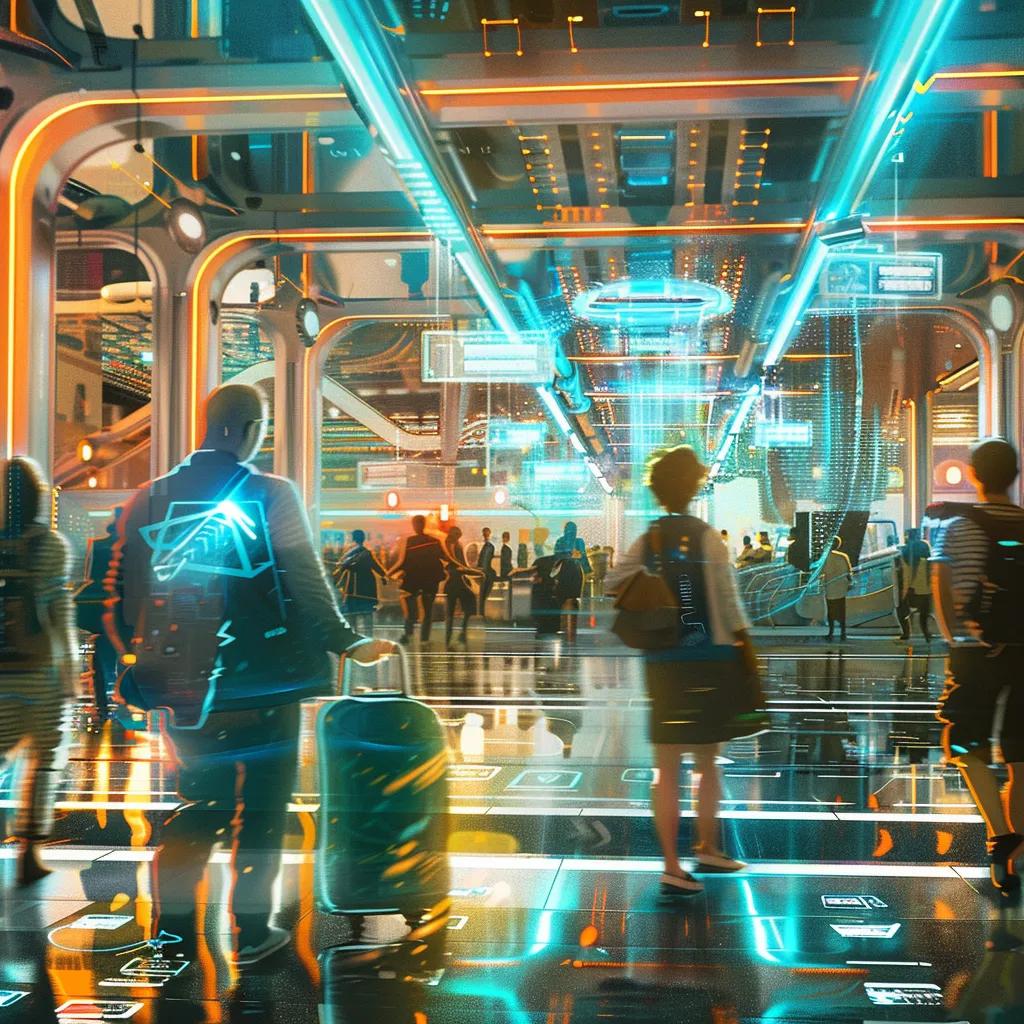
Teleportation will eliminate transit time and logistical delays, transforming daily commutes, leisure travel and global supply chains by instantly relocating people and goods.
How Will Teleportation Change Daily Commuting and Leisure Travel?
Teleportation will remove travel time from daily routines, boosting productivity and reducing stress.
- Zero-Delay Commute – Workers arrive instantly, expanding job access zones.
- On-Demand Leisure – Day trips across continents become commonplace.
- Elimination of Congestion – Urban traffic and public transport bottlenecks vanish.
Instant relocation enhances work–life balance and optimises personal time management.
What Are the Effects on Commercial Logistics and Supply Chains?
Teleportation will streamline cargo delivery, support just-in-time inventory and cut transport costs dramatically.
- Minimal Storage Needs – Goods teleport on demand, reducing warehousing.
- Rapid Restocking – Retailers maintain lean inventories with instant replenishment.
- Global Integration – Suppliers and producers synchronise operations across time zones instantly.
Supply chains will evolve into dynamic, decentralised networks prioritising speed and flexibility.
How Will Traditional Travel Sectors Like Airlines and Shipping Be Disrupted?
Airlines, shipping lines and rail operators will face massive declines in demand.
- Passenger Airlines – Obsolete for intercity travel; pivot to tourism experiences or cargo specialisation.
- Shipping Companies – Bulk goods and vehicles teleport, forcing a shift to teleporter infrastructure management.
- Hospitality and Tourism – Accommodation models adapt as travellers arrive everywhere instantly.
Service providers must innovate or repurpose assets to thrive in a teleport-enabled economy.
What Infrastructure Will Teleportation Require?
Teleportation demands specialised facilities, energy systems and network protocols to function reliably and safely.
Building these interconnected stations will support a global teleportation network that enhances mobility and supply efficiency.
Societal and Economic Transformations Driven by Teleportation
Teleportation will provoke profound shifts across economies, job markets, cities and cultural exchange by redefining distance and time.
How Will Teleportation Affect the Global Economy and Job Market?
Teleportation will displace transportation roles and spur demand for network maintenance, quantum engineering and station management.
Teleportation’s Impact on the Job Market
Teleportation is expected to significantly impact the job market, leading to job displacement in transportation sectors while simultaneously creating new opportunities in areas such as quantum engineering and teleporter network management. This shift necessitates workforce adaptation and the development of new skill sets.
This research supports the article’s claims about the economic and job market implications of teleportation, specifically the transformation of the transportation sector and the emergence of new job roles.
What Changes Will Occur in Urban Planning and City Development?
Cities will reorient around teleportation hubs, shifting real estate demand and public services:
- Distributed Hubs – Multiple micro-cities linked by teleportation become new economic centres.
- Reduced Commuter Rail – Land repurposed from stations to housing and green space.
- Flexible Zoning – Mixed-use developments evolve as distance barriers disappear.
Urban planners will prioritise hub placement and multimodal connectivity in smart city designs.
How Will Teleportation Influence Global Connectivity and Cultural Exchange?
Instant relocation fosters immediate cultural immersion and collaboration:
- Cross-Border Collaboration – Teams assemble face-to-face in seconds, accelerating innovation.
- Tourism Democratisation – Cultural sites accessible without long flights, broadening global understanding.
- Diaspora Engagement – Families connect physically without visa barriers, strengthening social bonds.
Teleportation promotes a truly global society by boosting direct person-to-person interaction.
How Will Daily Life and Human Experience Transform with Teleportation?
Personal routines and social dynamics will evolve as distance ceases to matter:
- Education On-Demand – Students attend global classrooms for single lectures.
- Healthcare Access – Specialists teleport to remote patients for critical procedures.
- Social Events – Friends and families gather instantly for life’s milestones.
The human experience will shift towards hyper-connectivity and flexible living patterns.
Ethical, Security, and Legal Hurdles for Teleportation

Teleportation raises novel ethical questions, security risks and regulatory needs that must be addressed before widespread adoption.
What Ethical Issues Arise Around Identity and Consciousness?
Teleportation of human subjects challenges notions of self and continuity:
- Duplicate Consciousness – How to ensure only one authentic “you” remains.
- Personhood Rights – Legal status of teleported individuals and potential copies.
- Informed Consent – Understanding risks of molecular reconstruction.
Ethical Concerns in Teleportation
The teleportation of human subjects raises complex ethical questions, particularly concerning identity and consciousness. The potential for creating duplicates and the legal status of teleported individuals are significant challenges that must be addressed before widespread adoption of teleportation technologies.
This citation addresses the ethical issues surrounding identity and consciousness, which are key considerations in the article’s discussion of the ethical, security, and legal challenges of teleportation.
How Will Privacy and Security Be Protected in Teleportation?
Teleportation networks must safeguard against interception, hacking or misuse:
- End-to-End Encryption – Quantum key distribution protects state data.
- Authentication Protocols – Biometric and cryptographic verification at each station.
- Intrusion Detection – Real-time monitoring for anomalous teleportation requests.
Robust safeguards will build trust and prevent unauthorized relocation or data theft.
What Regulatory and Legal Frameworks Are Needed for Teleportation?
Governments must enact statutes governing infrastructure, safety and liability:
- International Treaties – Standardise cross-border teleportation operations.
- Liability Laws – Define accountability for teleportation failures or identity errors.
- Licensing Regimes – Certify operators, stations and quantum network providers.
A comprehensive legal structure will facilitate safe, equitable access to teleportation.
What Environmental Considerations Affect Teleportation Technology?
Teleportation’s energy demands and potential carbon implications warrant evaluation:
- High-Density Power – Continuous entanglement generation requires significant electricity.
- Cooling Systems – Cryogenic or photonic cooling uses additional resources.
- Emission Trade-offs – Reduced aviation emissions versus power-plant outputs.
Balancing energy consumption with environmental benefits will guide sustainable teleporter network design.
Teleportation in Space Exploration and Virtual Realities
Teleportation concepts extend beyond Earth, supporting deep-space communication and immersive virtual presence.
What Role Will Teleportation Play in Interplanetary and Interstellar Travel?
Teleportation of data states can accelerate mission planning and remote operations:
- Instantaneous Data Links – Real-time control of rovers on Mars or asteroids.
- Crewless Missions – Teleportation of scientific instruments to distant probes.
- Future Human Transit – Hypothetical quantum jump gates for crew relocation.
Teleportation advances could boost exploration efficiency and reduce communication delays.
How Is Quantum Teleportation Used in Space Communication Today?
Agencies test satellite-based entanglement distribution for secure links:
- Ground-to-Satellite Experiments – Successful photon teleportation over 1,200 km in orbit.
- Quantum Key Distribution – Protects command-and-control channels from eavesdropping.
- Deep-Space Prototypes – Plans for interplanetary quantum networks under evaluation.
These early applications inform the development of a space-grade teleportation infrastructure.
What Are Holoportation and Virtual Teleportation as Precursors?
Holoportation uses volumetric capture and AR/VR to recreate lifelike avatars in remote locations:
- Real-Time 3D Capture – Users appear as holograms in distant studios.
- Collaborative Virtual Events – Meetings and concerts with presence perception.
- Medical Training – Tele-mentoring via immersive holographic overlays.
Virtual teleportation prototypes foreshadow the human desire for instant presence long before matter teleportation arrives.
Weighing the Pros and Cons of Instant Teleportation
Teleportation offers unmatched speed and convenience but poses risks to health, safety and social structures.
What Are the Key Advantages of Teleportation Over Traditional Travel?
Teleportation delivers transformative benefits:
- Extreme Speed – Journeys become instantaneous, eliminating travel time.
- Cost Reduction – Lower infrastructure and vehicle maintenance costs.
- Environmental Gains – Minimises fossil fuel use and associated emissions.
- Accessibility – Opens remote regions without building roads or airports.
These advantages promise to enhance global mobility, productivity and sustainability.
What Are the Potential Risks and Drawbacks of Teleportation?
Teleportation also introduces significant concerns:
- Biological Hazards – Molecular misalignment or corruption during reconstruction.
- Psychological Effects – Disorientation, identity anxiety or continuity distress.
- Social Disruption – Collapse of transport-dependent industries and communities.
- Security Threats – Unauthorized teleportation or illicit access to restricted areas.
Mitigating these risks will be crucial to realise teleportation’s promise safely.
Teleportation vs. Other Advanced Travel Technologies
Teleportation stands apart in speed, but high-speed rail, Hyperloop and autonomous vehicles offer incremental improvements within existing frameworks.
How Does Teleportation Differ from Hyperloop and Flying Cars?
Teleportation eliminates physical travel entirely, while Hyperloop and flying cars still require dedicated infrastructure and travel time.
- Hyperloop – Moves pods through low-pressure tubes at up to 1,200 km/h along fixed routes.
- Flying Cars – Offer point-to-point aerial routing at limited speeds and altitudes.
- Teleportation – Instantly relocates quantum information without spatial transit.
The absence of vehicles and tracks gives teleportation unmatched flexibility and speed.
What Are the Advantages of Teleportation Over High-Speed Rail and Autonomous Vehicles?
Compared with rail and self-driving cars, teleportation provides:
- Zero Congestion – No infrastructure bottlenecks or traffic delays.
- Scalable Reach – Hubs networked globally without continuous track construction.
- Reduced Maintenance – Eliminates wear-and-tear on moving parts.
- Adaptable Routing – Dynamic station-to-station connections on demand.
These competitive edges position teleportation as the ultimate leap beyond incremental transport innovations.
Conclusion: The Future of Travel and Teleportation
In summary, the emergence of teleportation, especially through the understanding of quantum teleportation, signifies a major change with wide-ranging effects. While the science of transferring quantum states is advancing quickly, providing better security and setting the stage for future networks, the idea of physically teleporting people is still a significant scientific and ethical challenge. The potential benefits, such as instant travel, economic boosts, and improved social and cultural connections, are enormous. However, these must be balanced against considerable difficulties, including ethical questions about identity, the need for strong security, the requirement for clear legal rules, and the environmental impact of energy use. As we work through these issues, the development of related technologies like holoportation already suggests a future where distance is less of a barrier, leading to a more connected and efficient world, provided we can successfully manage the challenges ahead.